
Distributive Property Meaning Made Simple

Understanding math becomes easier when we learn the building blocks that help us solve complex problems. One such block is the distributive property, a basic rule in arithmetic and algebra. When students ask about the distributive property meaning, they usually want to know why it matters and how it helps in solving equations. In this article, we’ll break it down using everyday language, simple math, and examples to make learning easy.
What Is the Distributive Property?
The distributive property allows you to multiply a number with a group of numbers inside parentheses. It shows how multiplication interacts with addition or subtraction. This rule says that you can multiply a number outside the parentheses with each number inside.
In other words, it distributes the multiplication across the numbers inside the parentheses.
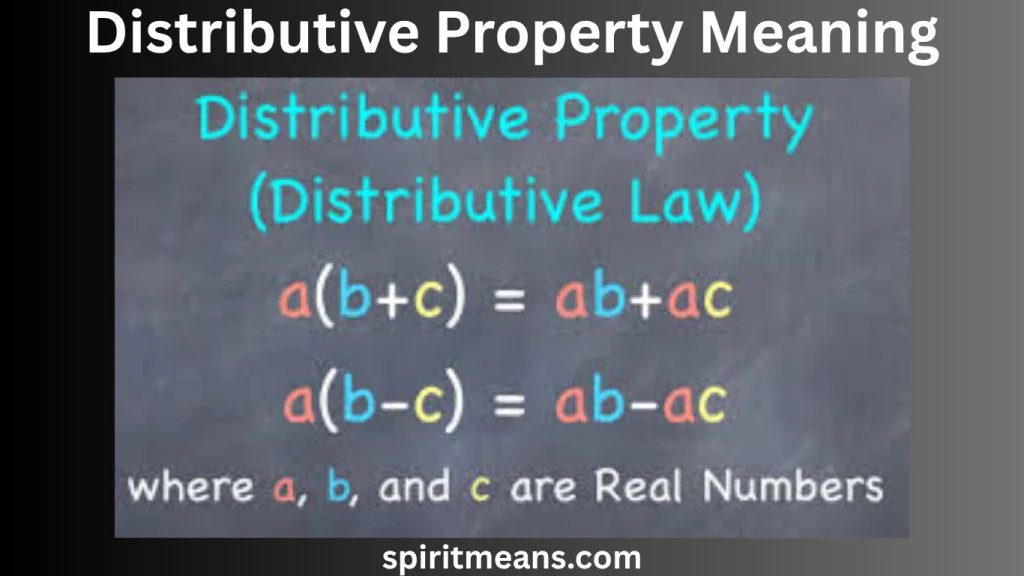
Here is the formula:
a × (b + c) = a × b + a × c
Or when subtraction is involved:
a × (b – c) = a × b – a × c
Both forms represent the same idea. They just use different math operations inside the parentheses.
Why Understanding the Distributive Property Matters?
The distributive property meaning goes beyond just memorizing a formula. It helps students understand how numbers work together. It shows how multiplication connects with addition or subtraction. When learners see this connection, they develop a deeper understanding of math.
This property is also useful for mental math, algebraic expressions, and simplifying equations. It builds a strong base for solving more complex problems in middle school and beyond. Teachers and textbooks use this property regularly when teaching how to expand or factor equations.
Real-Life Example
Imagine you are buying 3 gift boxes. Each box has 4 candies and 6 cookies inside. Instead of calculating total candies and cookies separately, you can group the items:
3 × (4 + 6)
Using the distributive property:
3 × 4 + 3 × 6 = 12 + 18 = 30 items total
This method is easy to follow and avoids extra steps. The meaning behind the distributive property becomes clear with real examples.
Table: Comparing Standard and Distributive Method
| Expression | Standard Method | Distributive Method |
| 5 × (2 + 3) | 5 × 5 = 25 | 5 × 2 + 5 × 3 = 10 + 15 = 25 |
| 4 × (7 – 2) | 4 × 5 = 20 | 4 × 7 – 4 × 2 = 28 – 8 = 20 |
| 6 × (1 + 4 + 5) | 6 × 10 = 60 | 6×1 + 6×4 + 6×5 = 6 + 24 + 30 = 60 |
As seen in the table, both methods give the same result, but the distributive method breaks it down into easier parts.
How It Helps in Algebra?
In algebra, you often see expressions like:
2(x + 5)
Here, you can’t add the terms inside the parentheses because x is a variable. So, you use the distributive property:
2 × x + 2 × 5 = 2x + 10
This step is the foundation for solving algebra problems. It’s used in factoring, solving equations, and simplifying expressions. Once you know what it means, you can apply it anywhere in math.
Understanding It with an Area Model
Area models also help students see how the distributive property meaning applies visually. Take a rectangle with one side labeled 3, and the other side split into two parts: 4 and 2. You can calculate the total area in two ways:
3 × (4 + 2) = 3 × 6 = 18
Or break it down into two rectangles:
3 × 4 = 12 and 3 × 2 = 6
Then add: 12 + 6 = 18
This visual method shows that the distributive property works by dividing a shape into smaller parts and adding the areas.
Important Rules to Remember
The distributive property only works over addition and subtraction, not over multiplication or division inside parentheses. You must multiply every term inside the parentheses before solving further.
If you skip a term, the result will be wrong. So always apply the multiplication carefully to each term.
Applying It in Mental Math
The distributive property meaning also helps with faster calculations in your head. For example, instead of multiplying 6 × 17, break 17 into 10 and 7:
6 × (10 + 7) = 6 × 10 + 6 × 7 = 60 + 42 = 102
This trick makes big numbers easier to work with. Students who use this property in mental math get faster at solving problems without writing them down.
When Should You Use It?
It’s helpful when:
- You can’t simplify inside the parentheses due to variables.
- You want to break a large number into smaller, easy parts.
- You need to expand or simplify expressions.
- You are solving algebraic equations.
Understanding when to use it is part of knowing what the distributive property meaning really is.
Summary Table: Key Facts About Distributive Property
| Concept | Explanation |
| Applies to | Addition and subtraction inside parentheses |
| Doesn’t apply to | Multiplication or division inside parentheses |
| Formula (Addition) | a(b + c) = ab + ac |
| Formula (Subtraction) | a(b – c) = ab – ac |
| Used in | Arithmetic, algebra, mental math, solving equations |
| Visual aid | Area models |
Common Mistakes to Avoid
Sometimes students forget to multiply each term inside the parentheses. This causes errors in the final result. Also, learners may try to use the distributive property with multiplication inside the parentheses, which doesn’t work.
To avoid confusion, always check:
- Are the terms inside added or subtracted?
- Have you multiplied each term inside?
- Have you used the correct sign after distributing?
Mistakes can be avoided by understanding the real distributive property meaning, not just copying steps.
Frequently Asked Questions
What does the distributive property mean in simple words?
It means you multiply a number outside parentheses with each number inside before adding or subtracting them.
Can I use the distributive property in subtraction too?
Yes. It works for both addition and subtraction, like this: a(b − c) = ab − ac.
Where is the distributive property used in real life?
It is used in shopping, construction, and any time you need to multiply combined values quickly.
Is the distributive property the same in algebra?
Yes, though it often includes variables. It helps expand or simplify expressions in algebra.
Why is the distributive property important?
It helps break down problems, solve equations, and understand how numbers and variables interact.
Conclusion
Understanding the distributive property meaning builds a strong math foundation. It explains how multiplication spreads over addition and subtraction. It also helps learners work through algebra and mental math more effectively. Whether using it in real-life shopping, visual models, or solving equations, this property shows up everywhere.
They make expressions easier to work with and help in calculating faster. Students who know how to apply it avoid common math mistakes. And as we’ve seen, it supports both simple arithmetic and complex algebra.
By breaking big tasks into smaller ones, the distributive property teaches problem-solving skills that go beyond the classroom. It’s one of the first tools in math that makes difficult tasks feel manageable.
If you’re just starting to learn algebra, understanding this rule will save you time, effort, and confusion. Keep practicing with real-life examples to fully understand how it works. Over time, you’ll see that knowing the distributive property meaning helps you become a stronger math learner.
Also, Read Meaning of a Butterfly: A Symbol of Change, Spirit, and Hope