
Sri Yantra Meaning: Journey to Inner Balance
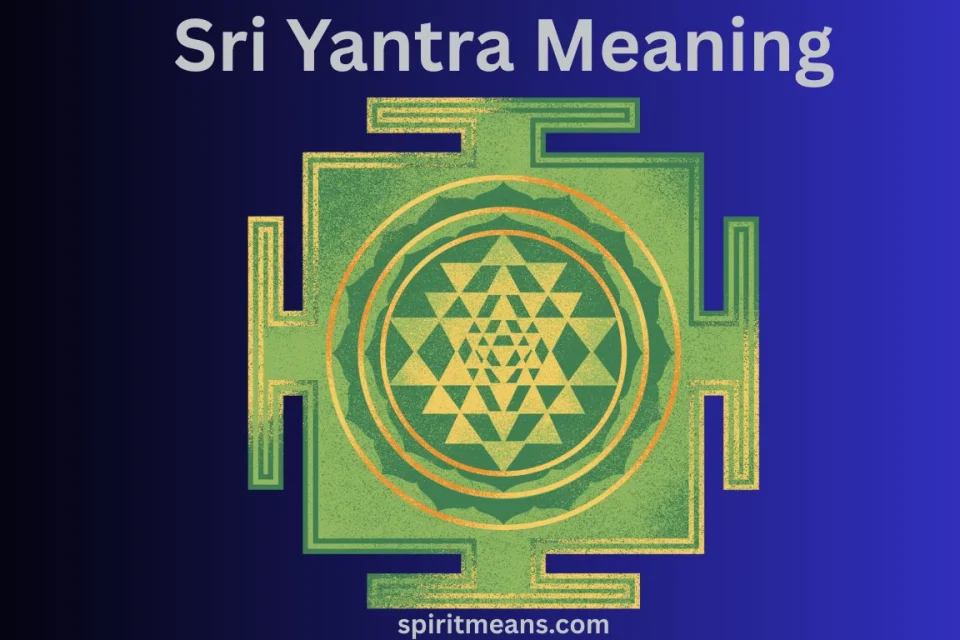
The Sri Yantra is an ancient sacred geometric diagram (“yantra”) found mainly in the Shri Vidya tradition of Hindu Tantra. It is also called Sri Chakra. It has nine interlocking triangles, arranged in such a way that they form 43 smaller triangles around a central point called the bindu. Four of those main triangles point upward (representing Shiva, the divine masculine) and five point downward (representing Shakti, the divine feminine).
People use it for meditation, worship, and to aid spiritual growth. The pattern is surrounded by lotus petals, circles, and an outer square with four gates. It acts as a kind of map of the universe, and a map of one’s own inner world.
Historical Context
The design of the Sri Yantra is ancient. It appears in sacred texts like the Lalita Sahasranama and in Tantric treatises. It is central to Srividya sadhana, a path of worship and meditation focusing on the union of Shiva and Shakti.
Symbols such as the lotus, the triangles, the bindu, the gates, and the square all have roots in Vedic, Puranic, and Tantric symbolism. Over centuries, many scholars, yogis, and devotees have studied its geometry, numerology, and spiritual implications.
The Layers of Symbolism
To understand sri yantra meaning, one must look layer by layer. Every part has significance.
| Layer | Name / Level | Symbolizes / Represents |
| Outermost square with gates (Bhupura) | Earth / physical world | The boundary, the four directions, the threshold between mundane reality and spiritual reality. |
| Sixteen-petalled lotus | Fulfillment of desire, sense realms | Signifies abundance, the senses, aspects of life one experiences outwardly. |
| Eight-petalled lotus | Stirring of mind, spiritual awakening | A more subtle layer, connection to inner awareness. |
| Multiple triangles (44 small, built from 9 main) | Cosmic structure, union of masculine & feminine energies | They represent Shiva (upward), Shakti (downward), and many smaller deities, energies and aspects of consciousness. |
| Central point (Bindu) | Pure consciousness, ultimate unity | It is the source, where dualities resolve, the point of spiritual focus. |
These layers from outside to inside show a journey: from the physical toward the spiritual; from multiplicity toward unity. That journey is central in sri yantra meaning.
Spiritual Purpose and Function
When people meditate on the Sri Yantra, they often use it to calm the mind, to align internal energy, and to reach higher awareness. It is used as a meditative tool, and the process of contemplation of each layer is believed to remove obstacles, reduce ego, and deepen insight.
In Srividya practice, the meaning of sri yantra meaning becomes lived knowledge when one chants associated mantras, performs ritual worship (puja), and visualizes the geometry moving inward toward the bindu. Symbolically one moves from the outer gates toward the center, from form toward formlessness.
Key Elements Explored
Triangles and Their Significance
The nine interlocking triangles are the heart of the design. The upward ones are symbolic of action, rising force, Shiva. The downward ones are receptive, creative, Shakti. Their intersection gives form to 43 smaller triangles, each embodying a deity or energy. This interplay of upward and downward energies underlies sri yantra meaning.
The Lotus Petals
There are two rings of lotus petals, one with sixteen petals, another with eight. They represent the unfolding consciousness, purity, and the unfolding of inner life. The petals also connect to elements, senses, and the mind. As awareness increases, one moves through these lotus rings toward inner stillness.
Gateways and the Outer Square
The outer square (Bhupura) with its four gateways is the threshold between outer reality and the inner sacred space. It frames the sacred geometry and reminds one of boundaries: physical, mental, emotional. Crossing those gates in meditation is crossing into deeper self-awareness.
The Bindu: Center of Meaning
At the center is the bindu. It is the point from which all triangles radiate, the focal point in meditation, the ultimate place of stillness. In terms of sri yantra meaning, it is the symbol of pure consciousness, beyond shape, beyond duality. Reaching or identifying with the bindu is considered the highest aim.
How It Is Used?
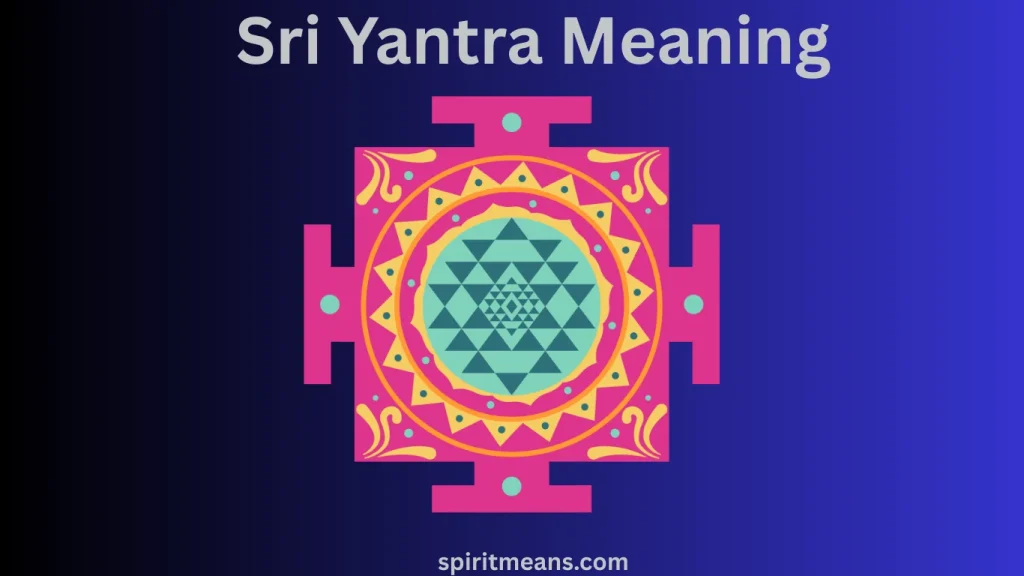
People place Sri Yantras in temples, homes, meditation rooms. They may draw it, have an engraved metal version, use it in ritual. Activation through pran pratishtha, mantras, offerings, and consistent meditation are important. It does more than decorate: it is meant to awaken an inner shift.
Some also use it in Vaastu Shastra (architecture) to harmonize energy flow in buildings. It is thought to attract positive energy, remove obstacles, and bring abundance. But its power depends on correct orientation, purity of placement, and devotion of the practitioner.
Psychological and Energetic Interpretations
Beyond traditional religious symbolism, people often see sri yantra meaning in psychological terms. The outer layers represent external life: senses, desires, worldly attachments. The inner layers mirror the mind: thoughts, emotions, ego. The innermost bindu is awareness itself.
Thus this symbol can act as a mirror. Looking into it helps one understand one’s own patterns and attachments. It also helps cultivate balance between energy and rest, action and stillness.
Summary Table: Components & Meanings
| Element | What it is | What it represents |
| 9 main triangles | Four upward + five downward | Union of masculine & feminine divine, cosmos structure |
| 43 small triangles | From intersection of main ones | Many deities, energies, facets of consciousness |
| Lotus petals (16 & 8) | Two rings around triangles | Senses, creation, unfolding awareness |
| Square (outer) with gates | Bhupura with 4 gates | Earth, directions, protection, external reality |
| Bindu (center point) | Dot at center | Pure consciousness, origin, spiritual union |
Interpretations in Different Traditions
In Srividya tradition, sri yantra meaning is not just theoretical; it is practical. The nine “avaranas” (layers) correspond to deities, yoginis, mantras, mudras. Worship and meditation proceed layer by layer as one penetrates deeper into the meaning.
Some tantric schools view the Sri Yantra as a 3-dimensional form (called Maha Meru) rising like a sacred mountain. In that view, the meaning includes ascent, heightening of consciousness, and cosmological structure in space as well as symbolic form. Modern practitioners also use it in mindfulness, in wellness, and in art. They see sri yantra meaning as universal: harmony, balance, unity, inner peace.
Frequently Asked Questions
What exactly does “Bindu” mean in the Sri Yantra?
The bindu is the central dot in the Sri Yantra. It means the point of origin, pure consciousness. It is the point where dualities merge. In sri yantra meaning, the bindu is the ultimate goal where one realizes the unity behind all form.
How many triangles are in a Sri Yantra and why?
There are nine main triangles: four pointing up, five pointing down. Their intersections yield 43 smaller triangles. This structure symbolizes the many facets of the cosmos and divine energies.
Can anyone meditate using the Sri Yantra?
Yes. With respect, focus, and guidance people from many backgrounds use it. One does better if one learns basics, uses a clean image or yantra, follows steps of meditation, possibly also mantra.
Where should one place a Sri Yantra in home?
Ideally in a clean, quiet space, often facing East or Northeast. It should be kept in a sacred or special place (altar or meditation room), not in bathrooms or cluttered spaces. Proper placement enhances its effectiveness.
Is Sri Yantra meaning just religious, or can it be spiritual even for non-Hindus?
Its geometric form, energy symbolism, psychological interpretation make it accessible to many people. Even outside religious setting, one can use it for meditation, art, or mental focus. It offers spiritual value beyond formal religion.
Conclusion
The sri yantra meaning is rich, deep, and layered. It is not merely a decoration or a symbol. It is a spiritual map which draws together masculine and feminine energies, outer world and inner life, form and formlessness. Starting from the outer square through lotus petals, triangles, and finally the bindu, it guides seekers toward unity and pure awareness.
Understanding it requires patience, study, and practice. When one uses it properly, with respect, devotion, and clarity, one can access its deeper significance: balance, harmony, spiritual awakening, and connection with the source.
Also, Read Gentlemen’s Club Meaning: Past and Present