
How Back Thru The Future Helps Businesses Complete an Electronic Data Destruction Request
Post Preview
Table of Contents
- Why an Electronic Data Destruction Request Is More Than a Pickup
- What to Include in Your Request
- Choosing the Right Data Destruction Method
- Protecting Chain of Custody From Collection Through Destruction
- When Onsite Electronic Data Destruction May Make Sense
- Compliance, Retention, and Legal Holds
- Combining Secure Destruction With Responsible Recycling
- Questions to Ask Before Scheduling Service
- Final Steps for a Strong Destruction Request
An electronic data destruction request should be treated as a controlled security and records-management process, not simply a request to remove outdated equipment. Devices such as hard drives, solid-state drives, backup tapes, phones, tablets, and servers can retain confidential business information long after employees stop using them.
Back Thru The Future helps organizations approach electronic data destruction with a documented plan for identifying assets, selecting an appropriate sanitization method, managing custody, and obtaining proof that the requested work was completed. This approach helps businesses reduce uncertainty when retiring technology that may contain customer, employee, financial, legal, health, or proprietary data.
Why an Electronic Data Destruction Request Is More Than a Pickup
Deleting files, emptying a recycle bin, or formatting a device may not be sufficient for every type of storage media or every business situation. A sound destruction request considers what information may be stored, whether the device will be reused, whether the organization has a legal reason to preserve the data, and how the asset will be controlled from the moment it leaves service.
Before equipment is collected or destroyed, the organization should identify the project scope. That includes the asset types, quantities, locations, sensitivity of the data, access restrictions, and desired completion date. It should also identify who has the authority to approve destruction.
What to Include in Your Request
A complete request gives Back Thru The Future the details needed to recommend a practical service model. Provide as much information as possible about the assets and the documentation your organization requires.
- Asset types: Hard drives, SSDs, tapes, laptops, desktops, servers, phones, tablets, or other electronic media.
- Approximate volume: Individual devices, boxes of drives, pallets of equipment, or a larger data-center inventory.
- Location and access needs: Office, warehouse, medical facility, data center, remote site, or secure storage area.
- Data sensitivity: Whether assets may contain personal, financial, health, legal, customer, employee, or proprietary information.
- Tracking requirements: Bulk counts, barcodes, serial-number reporting, or other asset-level validation.
- Preferred service method: On-site service, secure collection, plant-based destruction, degaussing, shredding, or a combined workflow.
- Required records: Chain-of-custody documentation, inventory reports, certificates of destruction, and recycling records.
Choosing the Right Data Destruction Method
The right method depends on the media itself, the sensitivity of the information, the organization’s reuse plans, and its internal policies. The NIST media sanitization guidance emphasizes risk-based decisions that account for both the information on the media and the characteristics of the device.
Hard Drives and Magnetic Media
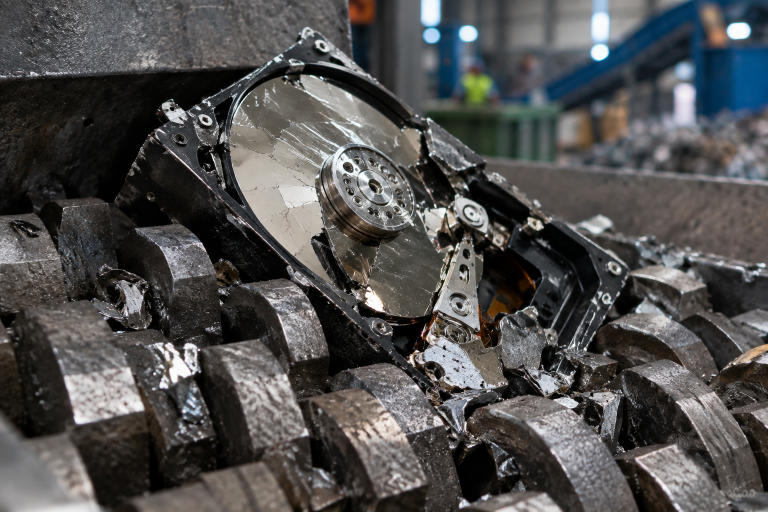
Traditional hard drives and certain magnetic media may be candidates for software-based clearing, degaussing, or physical destruction, depending on the project requirements. If reuse is not planned, physical destruction can provide a direct way to render the storage device unusable.
Solid-State Drives and Mobile Devices
SSDs, smartphones, tablets, and other flash-based devices require special consideration because data may be stored across multiple memory locations. Physical destruction can be appropriate when an organization needs to retire high-risk devices, cannot validate a different sanitization method, or does not intend to reuse the asset.
Backup Tapes and Legacy Media
Backup tapes can contain years of archived information and should not be overlooked during office moves, system migrations, or records-cleanup projects. A destruction request should identify tape formats, storage locations, and any retention obligations before the media is released for processing.
Protecting Chain of Custody From Collection Through Destruction
Secure destruction depends on more than the final shredding or sanitization step. Organizations should be able to account for the equipment while it is staged, collected, transported, processed, and documented. Back Thru The Future can help structure a project around controlled handling and the records needed for internal review.
Request documentation should clearly describe the service date, project location, asset counts or serial numbers when required, transfer details, destruction method, exceptions, and final certificate. If a discrepancy occurs, such as a missing device or damaged container, it should be recorded and resolved rather than ignored.
When Onsite Electronic Data Destruction May Make Sense
On-site destruction may be useful when a business wants to reduce custody transfers, observe the destruction process, or manage a high-sensitivity project at its own location. It can also be a practical option for office closures, large technology refreshes, secure facilities, and data-center decommissioning work.
Back Thru The Future can help businesses evaluate whether onsite shredding, onsite degaussing, secure transport to a processing facility, or a blended approach best fits the asset volume and security expectations. The decision should be made before equipment begins moving through the disposal process.
Compliance, Retention, and Legal Holds
Destruction should never begin until the organization confirms that the data is eligible for disposal. Litigation holds, investigations, audits, contractual obligations, tax requirements, and records-retention schedules can all affect whether a device or its contents must be preserved.
For healthcare organizations, federal guidance explains that electronic protected health information must be removed before media is reused or disposed of, or the media must be destroyed before disposal. The requirements for disposing of electronic health information also reinforce the importance of documented policies for final disposition and media reuse.
Back Thru The Future can support the execution and documentation of an approved destruction project, but the client remains responsible for confirming that no preservation duty prevents destruction.
Combining Secure Destruction With Responsible Recycling
Once data-bearing components have been sanitized or destroyed, the remaining electronic materials still need appropriate handling. Planning destruction and electronics recycling together can help organizations avoid unmanaged storage, reduce clutter, and maintain a more complete project record.
A well-planned request should specify what will happen to non-data-bearing equipment, shredded material, batteries, cables, and other electronics. This creates a clearer path from asset retirement through final processing.
Questions to Ask Before Scheduling Service
- Which media types can be handled under this request?
- Is on-site service available for the project location and volume?
- How will assets be inventoried, secured, and tracked?
- What destruction method is recommended for each media type?
- What records will be issued after completion?
- How will recyclable electronic materials be processed?
- Can the program support recurring or scheduled destruction needs?
Final Steps for a Strong Destruction Request
Start by identifying the devices, confirming destruction authority, and defining the level of tracking and documentation required. Then work with Back Thru The Future to select an appropriate service model, coordinate logistics, and establish the records needed after the project is complete.
Visit this website: a16z generative ai
By treating an electronic data destruction request as a documented lifecycle event, businesses can retire obsolete technology with stronger control over sensitive information, physical assets, and final recycling outcomes.