
Transform Images Into Dynamic Videos With Pollo.ai for Free

In an era where video content dominates digital platforms, the ability to create engaging videos quickly and efficiently has become increasingly valuable. A groundbreaking development in this space is the emergence of AI-powered image-to-video conversion technology, which allows users to breathe life into static images with remarkable ease. Among the platforms pioneering this technology, Pollo.ai has recently unveiled a comprehensive solution that empowers users to transform any image into compelling video content.
The Evolution of Visual Content Creation
The digital landscape has witnessed a significant shift toward video content in recent years. According to Cisco’s Visual Networking Index, video will account for 82% of all internet traffic by 2023. This trend has created both opportunities and challenges for content creators, marketers, and businesses who must produce engaging video content to remain competitive.
Traditionally, video production required specialized equipment, technical expertise, and substantial time investment. Even simple animations necessitated knowledge of complex software and animation principles. The emergence of AI-powered image-to-video technology represents a paradigm shift in this process, making video creation accessible to virtually anyone with a digital image.
Practical Applications Across Industries
The ability to convert images to videos has found applications across numerous fields:
Marketing and Advertising
Marketers have embraced this technology to transform product photography into dynamic advertisements. A static image of a product can become a rotating 3D showcase or be placed in a context that demonstrates its use. E-commerce platforms report significantly higher engagement rates with animated product displays compared to traditional photography.
Social Media Content Creation
Content creators and influencers use image-to-video technology to produce more engaging posts without increasing production time. On platforms where algorithms favor video content, this technology helps creators adapt existing assets to meet platform preferences.
Educational Resources
Educators have found value in animating diagrams and illustrations to explain complex concepts. A static diagram of a cell structure, for instance, can be transformed into an animation showing cellular processes, making abstract concepts more concrete for students.
Real Estate and Architecture
Property listings now frequently feature animated walkthroughs generated from still photographs, giving potential buyers a more immersive sense of spaces without requiring expensive videography or 3D modeling.
Pollo.ai’s Comprehensive Approach
Pollo.ai has positioned itself as a versatile solution in the image-to-video space by offering access to multiple AI models through a single, intuitive interface. Rather than developing a proprietary system with fixed capabilities, Pollo.ai integrates several leading video generation technologies, allowing users to select the model that best suits their specific project needs.
This multi-model approach addresses one of the key challenges in AI-generated content: different systems excel at different types of animations. Some models might better handle natural landscapes, while others might be superior for animating people or specific artistic styles. By providing access to various models, Pollo.ai ensures users can achieve optimal results regardless of their specific content requirements.
The platform stands out for its emphasis on customization and control. Users can specify not only what elements should move in their image but also how they should move, for how long, and with what end result. This level of detail allows for precise creative expression rather than generic animations.
The User Experience
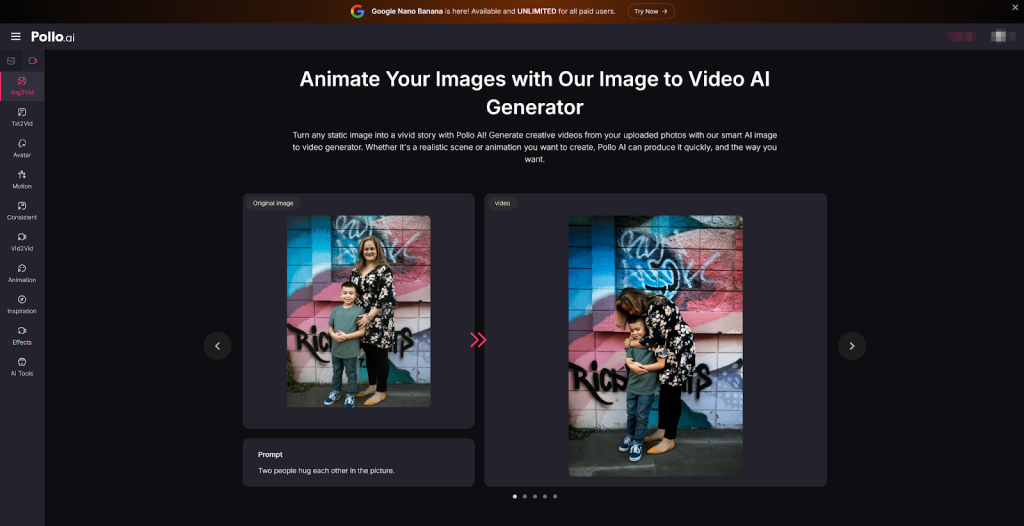
Converting an image to video through Pollo.ai follows a streamlined process designed to be accessible even to those with no technical background:
- Upload: Users begin by uploading their chosen image, which can be in common formats like JPG or PNG.
- Prompt: Users provide a text description of the desired animation. This could be as simple as “make the water ripple” or as specific as “have the person turn their head slightly to the right while smiling, with leaves gently falling in the background.”
- Customize: Additional settings allow users to adjust parameters like video duration, aspect ratio, and in some cases, end-frame specifications.
- Generate: The AI processes the request, typically delivering results within seconds to minutes depending on the complexity.
- Download and Share: The finished video can be downloaded in standard formats compatible with major social media platforms and video editing software.
What makes this process particularly noteworthy is its reliance on natural language instructions rather than technical parameters. Users describe what they want in everyday language, and the AI interprets these instructions accordingly.
Real-World Impact and User Testimonials
The practical impact of image-to-video technology is perhaps best illustrated through examples of how it’s being used in real-world scenarios:
Educational content creator Marcus Williams shares: “I create science materials for middle school teachers. Being able to animate diagrams has transformed how I explain concepts like plate tectonics or cell division. Teachers tell me students understand and retain the information better when they see these processes in motion.”
Marketing agency director Priya Patel notes: “We’ve incorporated image-to-video conversion into our standard workflow. It allows us to produce three times the content with the same resources, giving our clients more options and allowing for more extensive A/B testing of different visual approaches.”
Getting Started with Pollo.ai
For those interested in exploring image-to-video technology, Pollo.ai offers an accessible entry point with both free and premium tiers. The platform’s intuitive interface makes it approachable for beginners while offering enough customization options to satisfy more experienced creators.
The process begins with uploading an image—family photos, product photography, illustrations, or virtually any visual content can serve as a starting point. Users then describe the animation they envision, and the AI handles the technical aspects of bringing that vision to life.
For optimal results, the platform recommends:
- Starting with high-resolution, clear images
- Being specific in animation instructions
- Experimenting with different AI models for different types of content
- Considering the intended use case when selecting animation style and duration
Conclusion
The ability to transform static images into dynamic videos represents a significant leap forward in creative technology. What once required specialized skills, expensive equipment, and hours of work can now be accomplished in minutes with AI assistance. This democratization of video creation opens new possibilities for businesses, educators, artists, and everyday users looking to create more engaging content.
Platforms like Pollo.ai are at the forefront of making this technology accessible and versatile. By providing intuitive tools that bridge the gap between imagination and execution, they’re enabling a new generation of visual storytelling that combines the compositional strengths of photography with the engagement power of video.